ANI
29 Dec 2025, 06:59 GMT+10
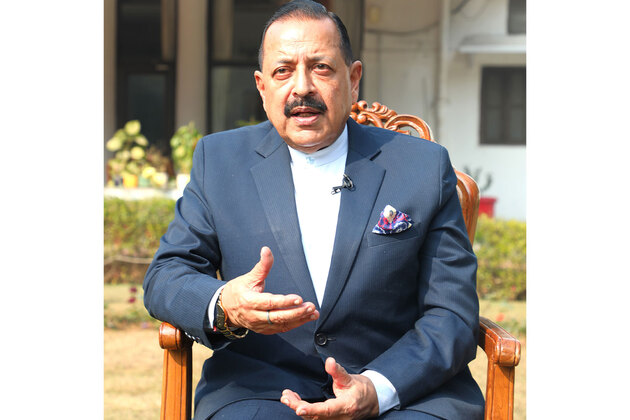
New Delhi [India], December 29 (ANI): SHANTI Bill will go down in history as one of the Modi government's biggest science reforms, said Union Minister of Science & Technology, Jitendra Singh, in a media interview here on Sunday.
The Minister observed that while parliamentary discourse on reforms has traditionally focused on public welfare schemes and governance measures, the long-term socio-economic character of the nation will increasingly be shaped by reforms in science and technology. The third term of Prime Minister Narendra Modi, Modi 3.0, is distinctly characterised by bold, structural reforms, with a strong emphasis on science, innovation, and entrepreneurship, he added.
SHANTI Bill represents a defining departure from convention by positioning science-driven reform at the centre of national transformation, said the minister.
Jitendra Singh said, 'The Bill must be seen as one of the most significant science reforms of the Modi Government,' noting that India has historically not framed scientific advancement within the reform narrative despite its decisive impact on future growth, industry, and global competitiveness.
Placing the SHANTI Bill within the larger context of Modi 3.0, Jitendra Singh said, 'The third term of Prime Minister Narendra Modi is distinctly characterised by bold, structural reforms, with a strong emphasis on science, innovation, and entrepreneurship.'
As per the release, he highlighted that while earlier reform phases were associated with landmark political and strategic decisions, Modi 3.0 will be remembered for breaking long-standing barriers in sectors that determine India's technological and economic future.
The Minister said that the SHANTI Bill marks a historic reform in India's nuclear sector, unlocking its potential for peaceful, clean, and sustainable energy while maintaining uncompromising standards of safety, sovereignty, and public interest. He emphasised that such a reform was inconceivable for over six decades and became possible only due to Prime Minister Modi's ability to dismantle legacy taboos and align India's policies with global best practices.
Reiterating India's long-standing commitment to peaceful nuclear use, Jitendra Singh recalled that from the time of Dr Homi Bhabha, India's nuclear programme was envisioned for development, healthcare, and energy security. The SHANTI Bill, he said, strengthens this foundational philosophy by enabling expansion for civilian purposes such as clean power generation, medical applications, and advanced research, while firmly excluding any deviation from peaceful intent.
Highlighting the demands of the emerging AI, quantum and data-driven economy, the Minister said nuclear energy is indispensable for providing reliable, round-the-clock power, unlike intermittent renewable sources. He noted that as India transitions away from fossil fuels and coal, nuclear energy will play a critical qualitative role in sustaining advanced technologies, digital infrastructure, and strategic sectors.
As per the release, Jitendra Singh also informed that India's nuclear power capacity has doubled from about 4.4 GW in 2014 to nearly 8.7 GW today, with a clear roadmap to scale up substantially in the coming years. He said, 'The government aims to reach around 100 GW of nuclear capacity by 2047, enabling nuclear energy to meet nearly 10 per cent of India's electricity requirements and support the national Net Zero commitment.'
The Minister also drew attention to the expanding role of nuclear science in healthcare, particularly in cancer diagnosis and treatment through nuclear medicine and isotopes. He said nuclear technology is increasingly contributing to life-saving medical interventions, reinforcing that atomic science today is a force for human welfare and societal well-being.
Referring to future readiness, Jitendra Singh said India is also moving towards Small Modular Reactors, which are suited for dense urban clusters, industrial corridors, and emerging economic zones. He said these reactors will further strengthen energy security while ensuring environmental responsibility.
The Minister noted that the SHANTI Bill has received wide acceptance across the scientific community, industry, startups, and the innovation ecosystem, reflecting a broad national consensus on the need to reform and modernise India's nuclear sector. He said the Bill exemplifies Modi 3.0's reform-first approach, where science-led policy decisions are shaping India's path towards a developed nation by 2047. (ANI)
Get a daily dose of India Gazette news through our daily email, its complimentary and keeps you fully up to date with world and business news as well.
Publish news of your business, community or sports group, personnel appointments, major event and more by submitting a news release to India Gazette.
More InformationNEW YORK CITY, New York: A powerful rally across precious metals gathered fresh momentum on December 26, with silver vaulting past...
NEW DELHI, India: The Indian Space Research Organisation (ISRO) on December 24 launched a next-generation US communication satellite,...
BEIJING, China: Foreign smartphone makers saw a sharp rebound in China last month, with shipments more than doubling from a year earlier...
NEW YORK CITY, New York: The arrival of new appetite-suppressing weight-loss pills is expected to speed up changes already underway...
BEIJING, China: China said it expects companies involved in negotiations over TikTok's U.S. operations to pursue solutions that respect...
SANTA CLARA, California: Nvidia has struck a deal with artificial intelligence startup Groq to license its chip technology and bring...
NEW DELHI, India: The Indian Space Research Organisation (ISRO) on December 24 launched a next-generation US communication satellite,...
New Delhi [India], December 29 (ANI): SHANTI Bill will go down in history as one of the Modi government's biggest science reforms,...
Sri Vijaya Puram (Andaman and Nicobar) [India], December 29 (ANI): Congress MP Manickam Tagore's comparison of the Rashtriya Swayamsevak...
New Delhi [India], December 29 (ANI): Vice-President CP Radhakrishnan will be on a two-day visit to Puducherry, Kerala and Tamil Nadu...
New Delhi [India], December 29 (ANI): Chairperson of the National Medical Commission (NMC), Dr Abhijat Chandrakant Sheth said Prime...
New Delhi [India], December 29 (ANI): After Prime Minister Narendra Modi on Sunday warned people against the misuse of antibiotics...